Habiatza Pulse · verified update: 9 October 2026. Jurisdiction: Spain. For Canary Islands assets, the outcome depends on the actual use of the property, the contract timeline and any applicable regional or local rules.
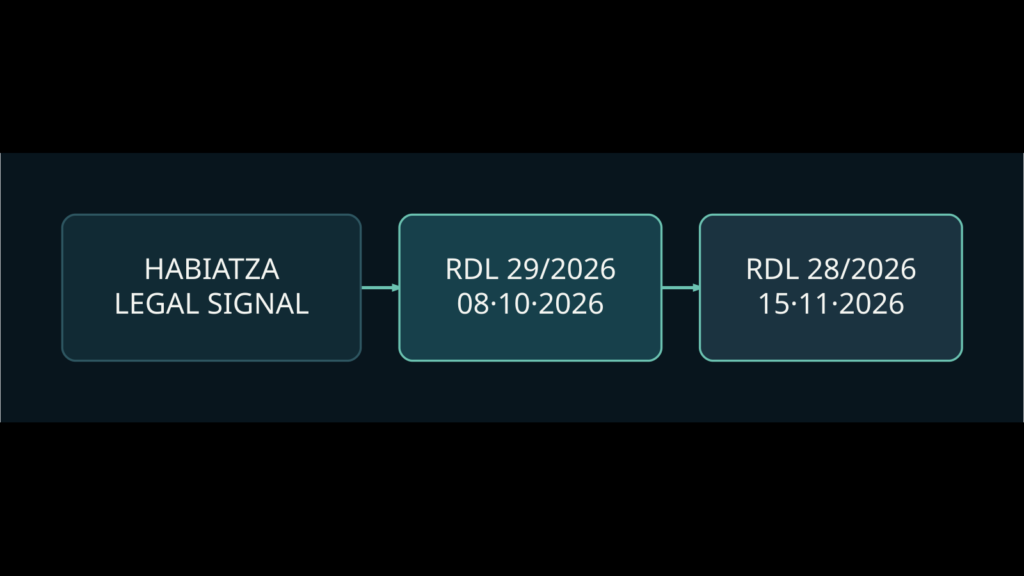
Spain has published two emergency housing decrees, but they do not operate on the same clock. Royal Decree-Law 29/2026 generally took effect on 8 October 2026, subject to specific exceptions. Royal Decree-Law 28/2026 specifies 15 November 2026. Both remain subject to the parliamentary review process applicable to decree-laws.
Executive answer: what should an asset owner or analyst establish first?
Build a four-part evidence record: effective date → genuine occupancy purpose → contractual and transitional timeline → territorial rules. A change in legislation is not itself proof that a particular lease has changed today, or that a local property market will react in a predictable way.
1. Two instruments, two operational timelines
| Instrument | Published | Effective date | Decision relevance |
|---|---|---|---|
| RDL 29/2026 | 7 Oct 2026 | Generally 8 Oct, with exceptions | Temporary-use arrangements, specific residential lease extensions and annual rent updates, each subject to statutory conditions. |
| RDL 28/2026 | 7 Oct 2026 | 15 Nov 2026 | Changes to the Spanish Urban Leases Act (LAU) concerning renewal, notice and certain compensation rules, including transitional protections. |
Verified fact: these dates are stated in the legislation published in Spain’s Official State Gazette (BOE). Not established: that all residential and temporary leases are immediately governed by the same new terms.
2. Temporary accommodation: classify the economic reality, not the label
Under RDL 29/2026, a qualifying temporary rental must correspond to a real, substantiated temporary need. The reason should be identified in the contract and supported by evidence. Describing a unit as a “seasonal let” does not override a permanent housing need.
The transitional provisions matter. Existing temporary contracts entered into before the new regime generally continue under their previous legal framework until the agreed end date, without renewal under that former regime. The position on a subsequent arrangement must be assessed under the applicable new rules. A blanket claim that every pre-existing temporary contract converts automatically on 8 October would misstate the transition.
For diligence, collect the actual reason for the stay, supporting documentation, signing date, term, extensions, and facts about occupancy. Rental listing duration alone is insufficient evidence of the legal purpose.
3. Residential leases: distinguish rent review from renewal and termination
RDL 29/2026 introduces specific rules for annual rent reviews falling within the relevant period through 31 December 2027. Depending on the statutory reference-price conditions, an increase may be excluded; in other covered circumstances, a newly agreed adjustment may apply and, without such agreement, the stated maximum is 2%. This is not a universal freeze applicable without examining the lease.
Its fifth final provision also establishes a conditional extraordinary extension of up to two years, requested by eligible tenants and subject to requirements and exceptions. Separately, RDL 28/2026 changes Article 10 of the LAU from 15 November, affecting the renewal and non-renewal framework, including certain notice and compensation rules. Its transitional provision preserves the legal effect of specified notices validly issued before publication.
Therefore, “all landlords must compensate for non-renewal” and “all rents are frozen” are not defensible summaries of the texts.
4. Canary Islands portfolios: territorial precision is not optional
State-level rental rules interact with applicable autonomous-community and sector-specific regimes. Tourist accommodation, a genuine temporary stay and a tenant’s permanent home must not be treated as interchangeable products. Likewise, no particular municipality should be described as a designated rent-stressed area without verifying the relevant formal designation.
Property Intelligence should map Spain → autonomous community → island → municipality → individual asset, while distinguishing legal applicability from market data. National regulation cannot establish an island-specific price response by itself. Explore the Habiatza methodology and property glossary.
5. A conditional 30-day outlook
Observed: two decrees published on 7 October with distinct commencement dates. Interpretation: landlords, managers and advisers have an immediate reason to audit their contract records. Scenario (through 8 November 2026; confidence: MEDIUM): more document checks and cautious decisions on lease strategy, assuming the published framework remains in force.
Assumptions: no immediate legislative reversal and no material new clarification. Invalidation signals: failure of parliamentary ratification, repeal, amendment, administrative guidance or significant court decisions. Not evidenced: any quantifiable immediate effect on Canary Islands sales prices, rental availability or investment yields.
6. Due-diligence checklist for one asset
- Establish actual use: primary residence, genuinely temporary stay or another legally distinct activity.
- Collect signed agreements, amendments, notices, rent-review dates and expiry dates.
- Map each question to the relevant statutory provision and effective date.
- Check transitional provisions and exceptions before applying the headline rule.
- Keep legal classification separate from market value, achievable rent and disposal strategy.
- Record missing evidence and seek case-specific legal advice where needed.
Reliable Property Intelligence is a traceable decision process: source → provision → effective date → contract evidence → territory → scenario. It is not a prediction engine built from legal headlines.
Evidence-led property decisions
For a structured review of asset-level assumptions and strategic options, contact Habiatza. This article provides general information, not individual legal advice.